Back to School Would You Rather Questions: A Creative Tool for Young Learners
Welcome back to school, young explorers! As the new academic year begins, educators and parents are always on the lookout for engaging and educational activities that can spark creativity and critical thinking in students. One such resource gaining popularity is the Back to School Would You Rather Question. This interactive approach to learning not only makes classroom time more enjoyable but also helps students develop essential skills like decision-making, reasoning, and articulation.
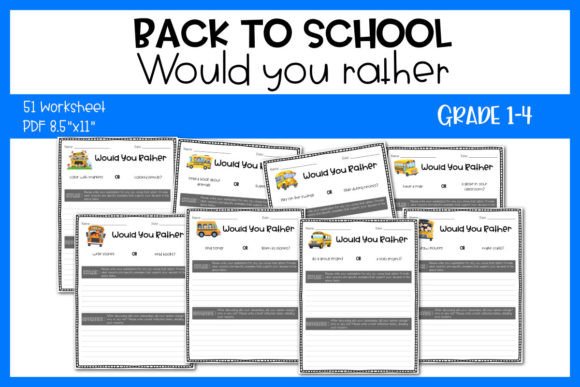
The Back to School Would You Rather Question is a set of thought-provoking scenarios designed for students in grades 1 through 4. Each prompt presents a choice between two options, encouraging students to think critically about their preferences and explain why they might choose one over the other. These questions are more than just fun—they serve as a powerful tool for enhancing communication skills and fostering reflective thinking.
One of the key benefits of using Back to School Would You Rather Questions is its adaptability. Whether used as a supplement to a lesson plan or as a standalone activity, these prompts can be integrated into various educational settings. Teachers can use them during class discussions to stimulate conversation, while homeschooling parents can incorporate them into daily writing exercises. The versatility of this resource makes it an excellent addition to any educator’s toolkit.
For instance, a typical prompt might ask: “Would you rather have a pet that never sleeps or a pet that always listens?” This question encourages students to consider the pros and cons of each option, helping them practice evaluating different perspectives. By engaging in such exercises, children learn to articulate their thoughts clearly and support their opinions with logical reasoning.
Another advantage of the Back to School Would You Rather Question is its ability to promote social-emotional learning. When students discuss their choices, they often share personal experiences and values, which fosters empathy and understanding among peers. These interactions can help build a supportive classroom environment where students feel comfortable expressing themselves.
Additionally, these prompts can be used to address common challenges faced by young learners. For example, students may struggle with making decisions or expressing their ideas effectively. By regularly engaging with Back to School Would You Rather Questions, they can gradually build confidence in their ability to think critically and communicate their thoughts.
Teachers and parents should also consider the practical applications of these questions. They can be used to create worksheets, games, or group activities that make learning more interactive and enjoyable. The Back to School Would You Rather Question workbook includes 51 pages of printable content, formatted to fit standard 8.5” x 11” paper sizes. This makes it easy to print and use in both classroom and home settings.
Whether you're an educator looking for creative lesson plans or a parent seeking ways to engage your child in meaningful learning, the Back to School Would You Rather Question offers a wide range of benefits. It provides a structured yet flexible approach to teaching that aligns with the developmental needs of young learners.
Moreover, the Back to School Would You Rather Question can be tailored to suit different learning styles and abilities. For visual learners, incorporating images or diagrams alongside the questions can enhance understanding. For auditory learners, discussing the scenarios in groups can provide additional engagement and reinforcement.
In conclusion, the Back to School Would You Rather Question is a valuable resource for educators and parents alike. Its ability to foster creativity, critical thinking, and communication skills makes it an excellent addition to any early childhood education program. By integrating these prompts into daily lessons or activities, teachers and parents can help students develop essential life skills in a fun and engaging way.